Lesson 3 of 7 / Cells and stem cells
Follow a protein through the cell
Why does a secretory cell need several organelles?
In this lesson: Link ribosomes, ER, Golgi bodies and lysosomes to their functions and appearance.
About 5 min
The key ideaRibosomes make polypeptides; rough ER and the Golgi process and route many proteins; vesicles carry material between compartments.
Explore the idea
Follow production and delivery
Attached ribosomes synthesise polypeptides entering the ER. The membrane system supports folding and early processing.
Smooth ER produces lipids without attached ribosomes. Lysosomes contain hydrolytic enzymes; they are a destination in the endomembrane system, not the producer of polypeptide chains.
Identify a real lysosome
Read the real micrograph
Find the large, irregular dark compartment near the centre. Compare its varied contents with the internal folds of nearby mitochondria.
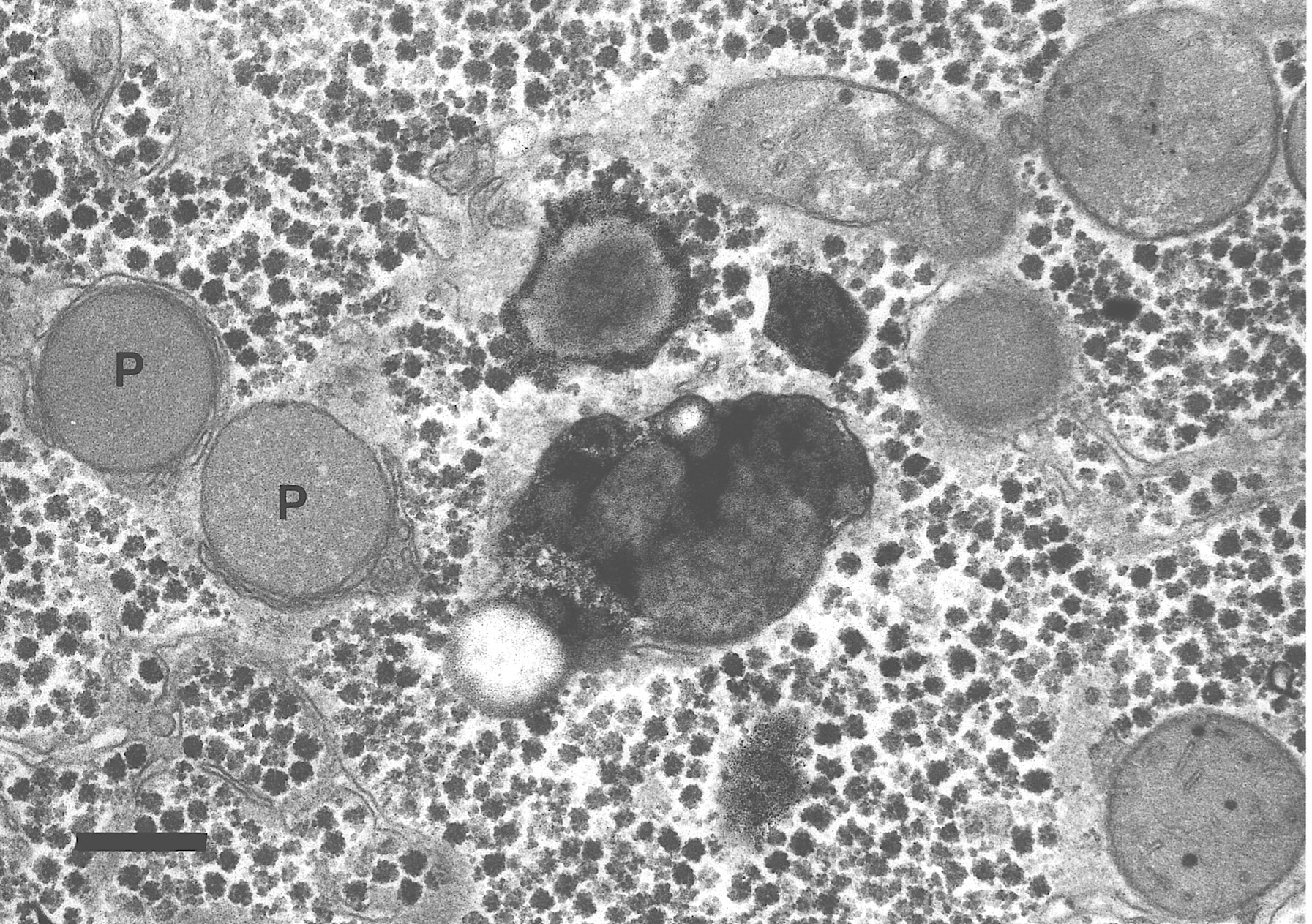
The source identifies the black bar as 0.5 micrometres. Peroxisomes provide context here; their detailed roles are outside this lesson. Display size changes with your screen; it is not a fixed microscope magnification.
Original schematic. Structures, cell numbers and distances are illustrative, not to scale.
Explanation
Ribosomes are small, non-membrane-bound structures that synthesise polypeptides. Many proteins used in the cytosol are made on free ribosomes. Ribosomes attached to rough endoplasmic reticulum make proteins entering the secretory or endomembrane pathway.
Rough ER is a membrane network with ribosomes on its cytosolic surface. Newly made proteins enter or become inserted into this system, where folding and early processing occur. Smooth ER lacks attached ribosomes and is involved in lipid synthesis and, in suitable cells, detoxification.
The Golgi body consists of stacked flattened membrane sacs and associated vesicles. It modifies, sorts and packages proteins and lipids. A vesicle can then fuse with the cell surface membrane, releasing a secreted product by exocytosis.
Lysosomes are membrane-bound compartments containing hydrolytic enzymes. Their acidic interior supports breakdown of material brought into the cell and worn-out components. A small dark vesicle is not automatically a lysosome: identification may need the image context or additional evidence.
Step by step
- 1
Synthesis
A ribosome makes a polypeptide.
- 2
Processing and sorting
For a secreted protein, the rough ER and Golgi form successive parts of its route.
- 3
Delivery
A vesicle carries the product to its destination.
Worked example
A cell releases a digestive enzyme
Why might a cell that secretes large amounts of protein have abundant rough ER and Golgi bodies?
One way to explain it
Attached ribosomes produce the polypeptides, the rough ER supports their early processing, and the Golgi modifies and packages them into vesicles for secretion. More secretory activity requires more of this machinery.
Why this answer works
- The product is a protein.
- Assign different steps to different structures.
- Connect abundance to demand, without claiming organelle count alone proves a cell's identity.
Is this true? "The Golgi body makes the amino acid chain."
Ribosomes assemble the chain. The Golgi modifies, sorts and packages products that reach it.