Lesson 2 of 9 / Nutrition and transport in flowering plants
Finding xylem and phloem
Which transport tissue is which in a stem or leaf section?
In this lesson: Identify xylem and phloem positions and functions in herbaceous dicot leaf and stem sections.
About 6 min
The key ideaXylem carries water and mineral ions; phloem carries food, mainly sucrose. Their positions help identify them in a dicot section.
Xylem carries water and mineral ions. Its mature vessels are hollow and dead with lignified walls. In a dicot stem bundle it is nearer the centre; in a leaf vein it is towards the upper surface.
Blue: xylem. Gold: phloem. Heavier outline: selected tissue. Original herbaceous dicot schematics, not to scale; a real microscope section may show only part of a structure.
Read a real microscope section
Find the ring of vascular bundles. Within a bundle, which large open vessels face the centre of the stem?
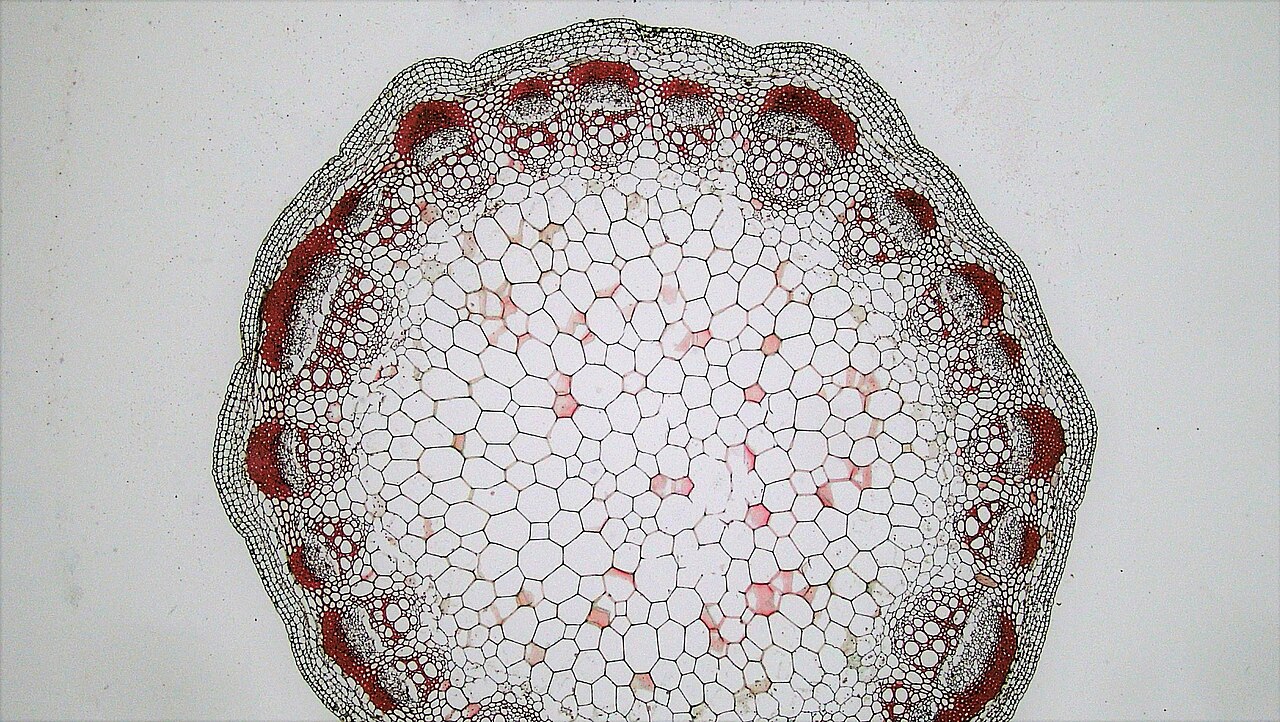
Image size changes with your screen. Use a stated scale bar for measurements; do not calculate from display size alone. Practise specimen observation and focusing in your laboratory.
Explanation
In a typical herbaceous dicot stem cross-section, vascular bundles form a ring. Within each bundle, xylem is nearer the centre and phloem is nearer the outside. The central space is a reference for orientation, not a transport tissue label.
In a leaf vein, xylem is normally towards the upper surface and phloem towards the lower surface. First identify whether you are viewing a leaf or a stem, then use the correct reference directions. The same words inside and outside do not describe both sections clearly.
Xylem vessels transport water and dissolved mineral ions from the roots towards the leaves. Their hollow interiors provide a continuous route, and thickened walls provide support. Phloem transports food, mainly sucrose, to places where it is used or stored.
Compare these positions in the real microscope sections as well as the schematic. Xylem commonly has larger open vessels with thick walls. Use position and visible tissue patterns together, rather than assuming every circular opening is a xylem vessel or that artificial colours are present in all specimens.
Step by step
- 1
Identify the organ
Stem and leaf sections have different reference directions.
- 2
Use position
Compare centre/outside in the stem or upper/lower in the leaf.
- 3
Confirm with structure and cargo
Match thick hollow xylem vessels with water/mineral ions and living phloem with food transport.
Worked example
A stem bundle
In a herbaceous dicot stem, tissue A lies on the inner side of a vascular bundle and has large thick-walled vessels. Identify it and its transported substances.
One way to explain it
A is xylem. It transports water and dissolved mineral ions from roots towards the leaves, and its lignified walls also provide support.
Why this answer works
- Inner position is relative to the stem centre.
- Large thick-walled vessels support the identification.
- State water and mineral ions, not sucrose.
Is this true? "Xylem and phloem carry the same substance in opposite directions."
Xylem supplies water and mineral ions; phloem carries food, mainly sucrose. Their main transported materials differ.