Lesson 1 of 6 / Viral and bacterial genetics
Virus structure and the boundary of life
Why is a virus not simply a very small cell?
In this lesson: Interpret viral structures and discuss viruses in relation to cell theory.
About 7 min
The key ideaViruses package a genome in protein, sometimes with an envelope, but lack the autonomous cellular machinery needed for reproduction.
Explore the mechanism
Which layer or structure does the job?
The lipid envelope and protein capsid are separate. Surface glycoproteins support host recognition; the genome is inherited. This spherical schematic is not the shape of every enveloped particle.
Original structures, not to scale. Green represents outer attachment/envelope structures, purple capsid, brown nucleic acid.
Read the real micrograph
Find the head, tail and fine tail fibres. Which of these structures helps contact a host bacterium?
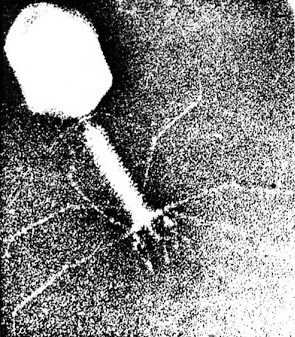
Use visible features and a stated scale bar. Display size is not fixed microscope magnification.
Explanation
A virion contains a nucleic-acid genome enclosed in a protein capsid. Enveloped viruses additionally have a lipid membrane containing viral glycoproteins, usually acquired from host membrane during budding. The envelope and capsid are different layers; neither is a peptidoglycan cell wall.
A typical tailed bacteriophage has a head containing the genome, a tail and attachment structures such as tail fibres. These enable recognition of a bacterial host and genome delivery. Viral surface proteins generally bind particular host receptors, contributing to host range and tissue specificity.
Viruses contain hereditary information, undergo mutation and evolve by natural selection. However, they have no ribosomes or independent cellular metabolism and cannot reproduce without a host cell. These mixed properties make the living/non-living boundary a matter of stated criteria rather than a useful one-word slogan.
Cell theory describes organisms as cellular units arising from other cells. Viruses are acellular and new particles assemble from components using host machinery rather than dividing as cells. They therefore challenge how broadly the concept of living entities is defined without demonstrating that ordinary cells spontaneously arise from non-cells.
Step by step
- 1
Identify layers
Keep envelope, capsid and genome distinct.
- 2
Identify attachment machinery
Relate surface structures to host recognition.
- 3
State criteria for life
Discuss both hereditary/evolutionary properties and host dependence.
Worked example
Work through the evidence
A particle contains RNA and evolves rapidly, but cannot synthesise protein outside a host. Is that evidence sufficient to call it a cell?
One way to explain it
No. Genetic information and evolution do not establish cellular organisation. Dependence on host ribosomes is consistent with an acellular virus.
Why this answer works
- Define the criterion being applied.
- Do not infer a nucleus or cytoplasm from the presence of RNA.
Is this true? "All viruses are bacteria lacking a cell wall."
Viruses are acellular particles; bacteria are cells with ribosomes and their own metabolic systems.