Lesson 3 of 5 / Respiration and ATP production
Oxidative phosphorylation
Why does blocking oxygen use stop most aerobic ATP production?
In this lesson: Explain electron transport, oxygen and mitochondrial chemiosmosis.
About 8 min
The key ideaElectron transfer pumps protons out of the matrix; their return through ATP synthase drives ATP formation, with oxygen accepting electrons at the end.
Explore the idea
Connect electron transfer to ATP synthesis
Energy from oxidation of reduced carriers supports proton movement towards the intermembrane space. Their controlled return to the matrix down the electrochemical gradient drives ATP synthesis.
Oxygen accepts electrons at the end of the respiratory chain and contributes to water formation. ATP is made on the matrix side of the inner mitochondrial membrane.
H+ symbols show a qualitative difference, not measured concentrations or an ATP-per-proton ratio. The gradient also has an electrical component. Pi means inorganic phosphate. Electron carriers and ATP synthase are simplified; the leak bypasses the normal coupling route.
What changes if oxygen becomes scarce?
Oxygen normally accepts electrons at the end of the respiratory chain. When this acceptance becomes limited, electron transfer and oxidation of reduced carriers slow. Less oxidised NAD and FAD are available for upstream dehydrogenations, so the link reaction and Krebs cycle can slow indirectly.
Oxidative ATP production falls; this does not imply that all ATP synthesis instantly stops. Glycolysis can still supply a small amount if NAD is regenerated, for example by fermentation.
Find mitochondrial cristae in a real micrograph
Try a real electron micrograph
Use the photograph on the right. Which internal pattern matches the diagram?
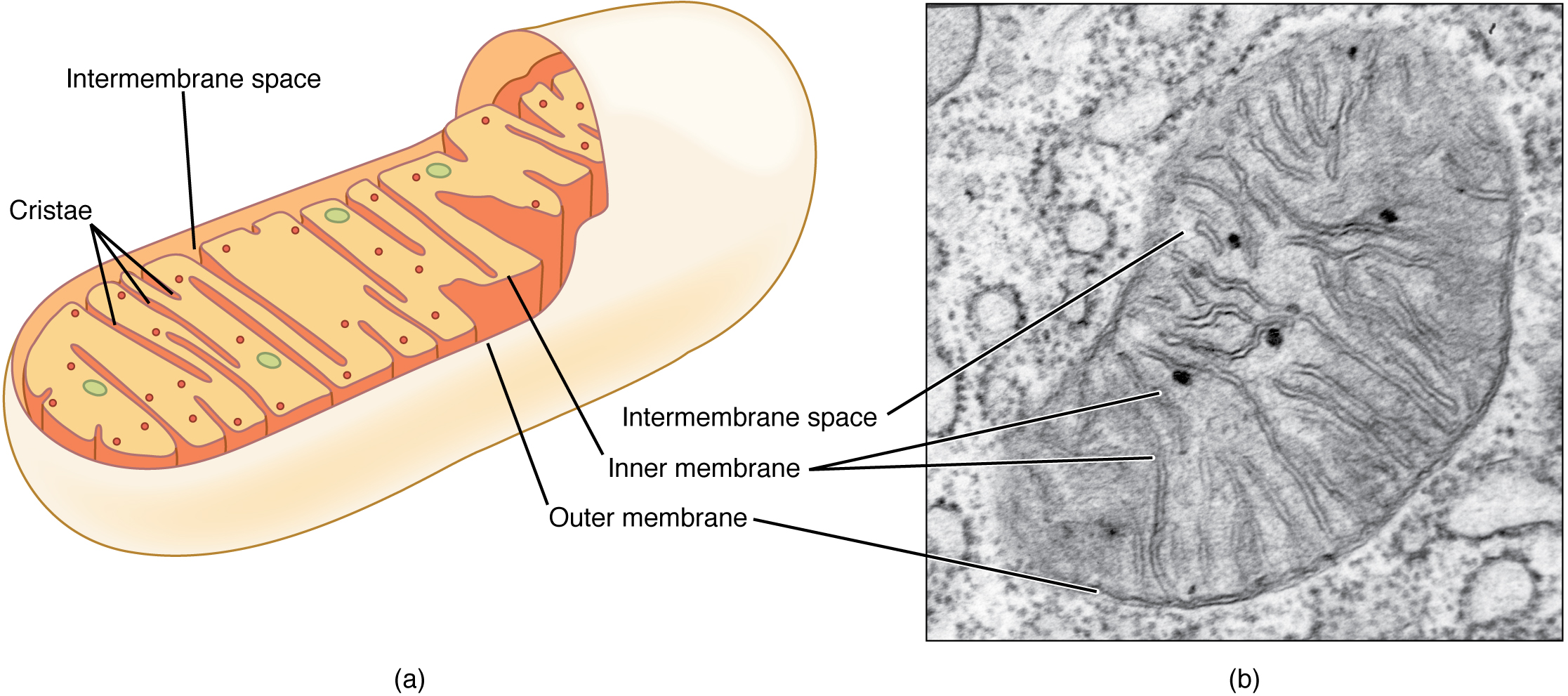
Different section angles change how an organelle looks. Match several visible features before naming it.
Explanation
Reduced NAD and reduced FAD supply electrons to an electron transport chain in the inner mitochondrial membrane. As electrons pass through carriers, released energy is coupled to pumping protons from the matrix into the intermembrane space. Cristae increase membrane area for this machinery.
The inner membrane limits proton leakage, allowing an electrochemical gradient to form. Protons return to the matrix through ATP synthase, driving phosphorylation of ADP using inorganic phosphate. This chemiosmotic coupling is oxidative phosphorylation, distinct from direct substrate-level phosphorylation.
Oxygen is the final electron acceptor and combines with electrons and protons to form water. Removing oxygen prevents continued electron flow through the normal aerobic chain, so reduced carriers cannot be efficiently reoxidised. This indirectly limits the link reaction and Krebs cycle as oxidised NAD and FAD become less available.
Most aerobic ATP production is linked to this pathway, but the exact total yield varies with coupling and cellular conditions. The syllabus explicitly does not require calculation of total ATP yield from oxidative phosphorylation. Explain the energy-transfer mechanism rather than memorising one universal ATP total.
Step by step
- 1
Locate the membrane
Use the inner mitochondrial membrane, not the outer membrane.
- 2
Trace electrons and protons separately
They have connected but different routes.
- 3
Predict a block
Loss of final electron acceptance prevents sustained carrier oxidation.
Worked example
Work through the evidence
An inhibitor blocks the last electron-transfer step to oxygen. Predict reduced NAD and ATP changes.
One way to explain it
Reduced NAD tends to accumulate because it cannot be efficiently reoxidised, while proton pumping and oxidative ATP production decline as electron flow stops.
Why this answer works
- The immediate block is downstream but affects upstream carrier availability.
- Some substrate-level ATP may still be produced if suitable pathways continue.
Is this true? "Oxygen supplies the phosphate group in ATP."
Inorganic phosphate supplies the phosphate; oxygen accepts electrons and protons to form water.