Lesson 1 of 5 / Photosynthesis and energy capture
Chloroplasts and light absorption
Why does an absorption spectrum differ from an action spectrum?
In this lesson: Recognise chloroplast compartments and interpret photosynthetic spectra.
About 7 min
The key ideaPigments absorb selected wavelengths; an action spectrum measures how effectively those wavelengths support photosynthesis.
Explore the idea
Read the y-axis before the peaks
This y-axis reports light absorbed by a pigment preparation. Absorption in blue and red regions is relatively strong; weaker green absorption does not imply every green photon is unusable by a whole leaf.
Original qualitative curves, independently normalised and not measured data. Do not infer exact rates, pigment concentrations or energy efficiency from their heights. Compare wavelength positions and the meaning of each axis under controlled photon supply.
Locate the stages in a real chloroplast
Read the real micrograph
Find stacked membranes and the surrounding stroma. Which visible feature distinguishes this from a mitochondrion?
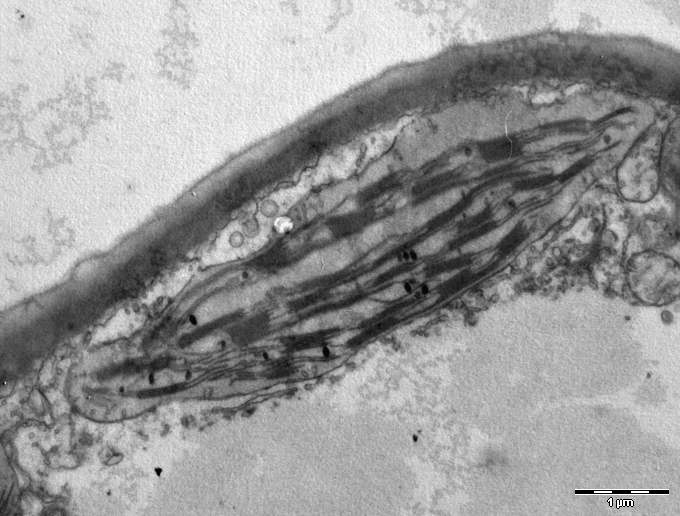
Use visible features and a stated scale bar. Display size is not fixed microscope magnification.
Explanation
A chloroplast has a double envelope surrounding stroma and an internal thylakoid membrane system. Stacks of thylakoids form grana, connected by unstacked membranes. Photosynthetic pigments and electron carriers are in thylakoid membranes; the stroma contains enzymes of carbon fixation. A real electron micrograph should be identified from these membrane patterns, not an assumed green colour.
An absorption spectrum plots how much light a pigment absorbs at each wavelength. Chlorophylls absorb strongly in blue and red regions and less strongly in much of the green region. Accessory pigments broaden the usable spectrum by absorbing additional wavelengths and transferring energy to reaction centres.
An action spectrum plots photosynthetic activity against wavelength, using a measure such as oxygen production. It reflects the combined functioning of pigments and the photosynthetic system, not merely one isolated pigment's absorbance. Similar peaks support a link between absorption and photosynthetic effectiveness.
For a fair wavelength comparison, control incident photon supply as appropriate, temperature, carbon dioxide availability and sample amount. Green light is often less effective in the simple spectrum, not necessarily completely unusable. A whole leaf can behave differently from purified pigment in a cuvette because of absorption, scattering and tissue structure.
Step by step
- 1
Read the y-axis
Absorbance and reaction rate are different variables.
- 2
Compare peak positions
Relate pigment absorption to biological activity.
- 3
Check controls
Unequal illumination can confound wavelength effects.
Worked example
Work through the evidence
A wavelength is weakly absorbed by chlorophyll a alone but supports some photosynthesis in a leaf. Suggest an explanation.
One way to explain it
Accessory pigments or other chlorophylls can absorb that light and transfer excitation energy to reaction centres, so a whole-system action spectrum differs from one pigment's spectrum.
Why this answer works
- The leaf contains more than one pigment.
- An action spectrum measures the combined system.
Is this true? "An action spectrum directly measures how much purified chlorophyll is present."
It measures the effectiveness of wavelengths in driving photosynthesis under the assay conditions.